Search This Blog

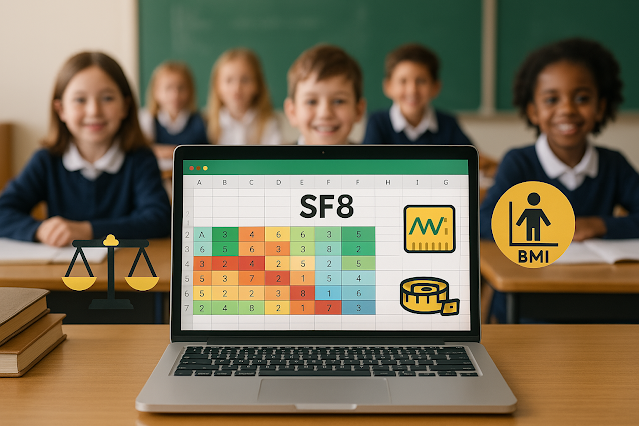
๐Ÿ“ฅ Download Automated SF8 With BMI Calculator – A Smarter Way to Monitor Student Health ๐Ÿ“Š

Why Modernize SF8?

In today’s digital age, traditional pen-and-paper forms no longer meet the demand for efficient health and nutrition reporting in schools. That’s why an automated SF8 form with a BMI calculator is essential. This new approach not only saves time but also ensures accurate learner health data. The Department of Education's School Form 8 (SF8) is crucial in tracking each student’s nutritional status and height-for-age (HFA) metrics—but imagine doing it in seconds, not hours.
๐Ÿ“˜ What Is SF8 and Why It Matters?

The SF8 or School Form 8 – Learner’s Basic Health and Nutrition Report is a DepEd-mandated document that records every student’s physical wellness, particularly weight, height, BMI (Body Mass Index), and nutritional assessment. It's applicable to all grade levels, from Kindergarten to Senior High School. The traditional process is tedious, but integrating an automated BMI calculator not only makes the process faster but also reduces manual errors.

CLICK HERE TO DOWNLOAD SF8 NOW.

According to DepEd Order No. 13, s. 2017, maintaining accurate health records is vital for effective intervention and feeding programs. With this, teachers and school health coordinators can monitor the nutritional trends among learners and respond with targeted health strategies.

⚙️ How the Automated SF8 With BMI Works

This innovation is designed with built-in formulas to calculate BMI, classify nutritional status (such as Normal, Wasted, Obese, etc.), and auto-fill Height-for-Age assessments. Teachers simply input a learner's weight and height, and the system will instantly display BMI and its corresponding category using World Health Organization (WHO) growth standards.

The tool uses this formula:

BMI = Weight (kg) ÷ [Height (m)]²

Once BMI is determined, it automatically falls into a category:

  • Severely Wasted

  • Wasted

  • Normal

  • Overweight

  • Obese

Meanwhile, HFA classification determines if the learner is Severely Stunted, Stunted, Normal, or Tall, providing another layer of health assessment.

๐Ÿ“ˆ The Benefits of an Automated SF8

Modernizing the SF8 form offers numerous advantages. First, it promotes data accuracy, minimizing human error in complex BMI calculations. Second, it drastically reduces workload for teachers and health officers who often have to compute dozens—if not hundreds—of learners manually.

Additionally, with its automated summary tables, schools can instantly generate reports by sex, nutritional status, and height-for-age, allowing quicker response to malnutrition and growth issues. According to the National Nutrition Council, timely health interventions are key to preventing long-term physical and cognitive issues in children.

๐Ÿ“‚ Why You Should Use This Version of SF8

This enhanced SF8 template is fully editable, Excel-based, and ready for school year roll-out. It’s designed based on the most recent forms distributed by DepEd and aligned with the 2017 SFRT standards. Whether you’re handling elementary, junior high, or senior high school learners, this tool ensures your health records are up-to-date and reliable.

It includes fields such as:

  • School Name, Grade, Section

  • Learner Reference Number (LRN)

  • Complete Name, Birthdate, Age

  • Weight, Height, BMI, BMI Category

  • Nutritional Status and HFA Remarks

It also auto-generates a Summary Table of results, so health coordinators can submit consolidated reports without delay.

✅ Trusted and Data-Aligned

This version follows data privacy protocols and is modeled after recommendations from DepEd Health and Nutrition Center (HNC) and UNICEF Philippines, which emphasize the importance of accessible digital health tools for education professionals.

๐Ÿ“˜ Mapping Literacy Growth: Understanding Reading Profiles in Key Stage 1 vs. Key Stages 2–3 ๐ŸŒฑ๐Ÿ“–

Reading is more than just a school subject—it’s a lifelong foundation for learning, communication, and critical thinking. In the Philippines, two major assessment tools help educators gauge where learners are on their literacy journey: the CRLA Profiles for Key Stage 1 (Grades 1–3) and the Phil-IRI Profiles for Key Stages 2–3 (Grades 4–10).

๐Ÿ“˜ Mapping Literacy Growth: Understanding Reading Profiles in Key Stage 1 vs. Key Stages 2–3 ๐ŸŒฑ๐Ÿ“–

Each of these tools defines reading profiles that reflect a learner’s ability to decode, understand, and respond to texts. While both aim to improve reading performance, they cater to different stages of cognitive and language development. Let’s examine their profile descriptions and understand how they guide effective reading instruction.


๐Ÿง’ Key Stage 1 (CRLA): Early Reading Development Begins Here ๐Ÿ…ฐ️

In the early grades, students are still forming the building blocks of reading—letter recognition, phonemic awareness, and basic comprehension. The CRLA (Comprehensive Reading Literacy Assessment) captures this phase through four distinct profiles:

๐Ÿ”ค Emerging Profile

Learners in this stage show limited phonological awareness and often know only a few letters. They try to read by sounding out or identifying syllables but fail to recognize whole words. Comprehension is weak or absent. According to the Department of Education, these learners need intensive, targeted instruction to build foundational skills like phonics and decoding.

๐Ÿ›  Developing Profile

Here, learners begin to decode simple words and phrases. They possess basic phonological skills but require constant teacher support to improve automaticity, fluency, and text comprehension. This stage highlights the importance of guided reading strategies, especially in L1 (first language) environments.

๐Ÿ”„ Transitioning Profile

These learners show improved skills but are still mastering accuracy and fluency. They benefit from regular practice to sharpen decoding and comprehension, though they are no longer completely dependent. Instructional scaffolding remains essential at this level.

๐ŸŒŸ Reading at Grade Level

Students at this level have solid letter knowledge, strong phonological awareness, and competent decoding skills. They can read various texts in L1 and L2, and are starting to develop in L3. They show increasing independence in both oral reading fluency and text understanding—a sign of readiness for more complex academic content.


๐Ÿง‘ Key Stages 2–3 (Phil-IRI): From Struggling to Fluent Readers ๐Ÿ“š

Once learners enter Grades 4–10, they are expected to move from learning how to read to using reading as a tool for learning. The Phil-IRI (Philippine Informal Reading Inventory) describes their reading capacity using three practical levels:

๐Ÿšซ Frustration Level

Learners at this stage are unable to handle grade-level texts independently. They show serious difficulties in decoding, fluency, and comprehension. According to UNESCO, readers in this group are at high risk of academic failure without urgent and targeted interventions.

๐Ÿงฉ Instructional Level

At this level, learners can partially comprehend texts with support. They’re developing, but not yet ready to read independently. This profile mirrors the CRLA's Transitioning stage and demands focused instruction, peer collaboration, and teacher-led guidance. As noted by the World Bank, learners here can still close the literacy gap with consistent, strategic help.

Independent Level

The goal of every literacy program, this level represents readers who can handle texts on their own. They demonstrate strong fluency, comprehension, and can read across subjects. These learners thrive with minimal or no assistance, and their skills support higher-order thinking, analysis, and independent study—hallmarks of academic readiness.


๐Ÿ” Why the Distinction Matters: Matching Instruction to Developmental Needs

By comparing CRLA (Key Stage 1) and Phil-IRI (Key Stages 2–3) profiles, teachers can better tailor reading programs. These descriptions don’t just classify learners—they provide a roadmap for intervention. Here’s why this distinction is critical:

  • CRLA focuses on foundational literacy—ideal for early readers developing core phonics and decoding.

  • Phil-IRI assesses applied literacy skills—vital for older students using reading in content areas like science, history, and math.

Aligning teaching strategies with these profiles helps bridge learning gaps, prevents dropouts, and ensures that no child is left behind in literacy.


๐Ÿง  Research-Backed Insights

According to the Department of Education (Philippines), integrating CRLA and Phil-IRI results allows educators to trace student growth and implement data-driven reading interventions. Meanwhile, the World Bank Learning Poverty Report stresses that identifying struggling readers early through such tools is key to addressing functional illiteracy.

By understanding these reading profile descriptions, educators are empowered to foster confident, fluent readers ready for lifelong success.

๐Ÿ“ฅ Download Here: Rapid Math Assessment (RMA) for Grades 7–10 BOSY Score Sheet + School Summary

 As schools prepare for a more data-informed school year, the Rapid Math Assessment (RMA) has become a cornerstone tool in tracking and strengthening the mathematics proficiency of Filipino learners. Whether you're handling Grade 6 End-of-School-Year (EOSY) assessments or mapping student readiness for Grades 7 to 10, the Beginning-of-School-Year (BOSY) Score Sheet and School Summary downloads are vital instruments for success.

๐Ÿ“ฅ Download Here: Rapid Math Assessment (RMA) for Grades 7–10 BOSY Score Sheet + School Summary


๐Ÿ“Œ What Is the RMA and Why Should Schools Use It?

The Rapid Math Assessment (RMA) is a diagnostic tool used to evaluate core mathematical skills at the start and end of the academic year. While it may appear routine, its value lies in how it provides quick, reliable insights into a student’s mathematical foundation. For Key Stage 3 (Grades 7 to 10), this helps teachers detect learning gaps early and customize interventions. For Grade 6 EOSY, it ensures a smoother transition into high school by gauging cumulative understanding.

According to DepEd’s Bureau of Education Assessment, formative assessments like the RMA are essential for improving learner outcomes by “providing actionable evidence to drive classroom instruction.” This means RMA is not just a test—it’s a planning tool that impacts daily teaching.


๐Ÿ“Š What You’ll Get in This Download Package ⬇️

In this comprehensive RMA download, educators will receive two important files:

  • The BOSY Score Sheet, formatted for ease of entry and class-level data analysis.

  • The BOSY School Summary, which consolidates performance data across sections and grade levels, giving school heads a bird’s eye view of mathematics trends.

These tools are designed to support school-based planning, promote accountability, and empower Math coordinators and subject teachers with reliable data.


๐Ÿ“š Who Should Use the RMA Tools?

These downloadable tools are ideal for:

  • Grade 6 teachers preparing EOSY reports and transition strategies

  • Junior high school math teachers tracking BOSY performance

  • School heads and academic coordinators aligning school improvement plans with data

  • Division math supervisors analyzing trends across multiple schools

By standardizing how we collect and interpret data, the RMA download kit ensures transparency and comparability across classrooms and districts.


๐Ÿ“Ž Where Does RMA Fit in the Broader Learning Framework?

The RMA aligns with the Most Essential Learning Competencies (MELCs) and the learning continuity plan developed during the pandemic. According to education think tank Philippine Business for Education (PBEd), such assessments bridge the gap between curriculum intentions and classroom realities, helping teachers “identify what works and what needs intervention.”

By using the BOSY RMA score sheets, schools can identify patterns such as:

  • Persistent difficulty with number operations

  • Strengths in geometry and measurement

  • Section-specific gaps that require differentiated teaching

These are not abstract numbers; they are actionable insights.


๐Ÿ“ฅ How to Access the Free RMA Score Sheet & Summary

Teachers and school leaders can download the RMA files directly using the links provided below. They are fully editable, printable, and compatible with both Microsoft Excel and Google Sheets.

Make sure to input your division name, school ID, and other required data before encoding scores. The built-in formulas will auto-generate school summaries and pass/fail indicators to help you interpret results instantly.

CLICK HERE TO DOWNLOAD RMA SCORESHEETS KS1, KS2, AND KS3

๐Ÿ“ [Download BOSY Score Sheet – Grades 7–10]
๐Ÿ“ [Download BOSY School Summary – Grades 7–10]


✅ Why These Downloads Matter More Than Ever

In a post-pandemic educational landscape, rapid diagnostics are key. The earlier we identify who needs help, the sooner we can respond. With the RMA, schools have a ready-made solution to ensure no learner is left behind in math. And best of all—these tools are free, flexible, and teacher-friendly.


๐Ÿง  Final Thoughts

The Rapid Math Assessment is more than just an early-year requirement—it’s a strategic educational tool. From identifying top performers to flagging those at risk, the BOSY RMA downloadables enable data-based instruction that leads to real improvement. Let’s make every number count.

๐ŸŽ’๐Ÿ“š All Set for School Year 2025: DepEd Gears Up for June Opening with Enhanced Safety & Learning Tools ๐Ÿ“ฑ๐Ÿš”

The Department of Education (DepEd) is rolling out a comprehensive and well-coordinated back-to-school plan this June 16, welcoming around 27 million students across the country. This year’s opening is marked not only by a return to the June-to-March academic calendar but also by a major effort in infrastructure readiness, digital resource distribution, and tightened security measures.

๐ŸŽ’๐Ÿ“š All Set for School Year 2025: DepEd Gears Up for June Opening with Enhanced Safety & Learning Tools ๐Ÿ“ฑ๐Ÿš”

๐ŸŽ“ Back to Traditional School Calendar: A Strategic Shift for Stability

After years of experimenting with an adjusted academic calendar due to pandemic and weather-related disruptions, the DepEd has officially reverted to the June-to-March school year. According to President Ferdinand R. Marcos Jr., this move aims to minimize the recurring losses in classroom learning due to typhoons and other natural disturbances that are more frequent during the rainy season, particularly from July to October. Education Secretary Sonny Angara, who recently took the helm of the department, emphasized the importance of “calendar alignment with optimal weather conditions” to protect learning continuity and student well-being.

This decision is backed by education advocates and local government units, who have long campaigned for more climate-responsive academic scheduling. As stated in a recent policy brief from the Philippine Institute for Development Studies (PIDS), learning disruptions due to extreme weather have had measurable negative impacts on student performance and school attendance. The return to the traditional calendar is therefore a timely, data-driven response.

๐Ÿ–ฅ️ Digital Tools & Tech in the Classroom: Equipping Schools for the Future

In a move to modernize Philippine classrooms, DepEd has successfully distributed 33,539 laptops to teachers and 5,360 units to non-teaching staff as part of its computerization program. Along with these, nearly 26,000 smart TV packages equipped with external hard drives have been procured to enhance multimedia-based learning.

These smart TVs, when used with offline content delivery systems, are particularly useful in geographically isolated and disadvantaged areas where stable internet connectivity remains a challenge. According to a UNESCO education report, integrating ICT in education significantly improves student engagement and knowledge retention—especially when supported by teacher training and quality content.

๐Ÿ“– Textbook Procurement Nears Full Distribution

While technology plays an increasing role, printed learning materials remain critical—especially for early grade learners. DepEd reports that textbook procurement for Grades 1, 4, and 7 is at 99% completion, with Grades 2, 5, and 8 currently halfway through procurement. Full coverage for other grade levels is expected to commence next year.

Experts from the Southeast Asian Ministers of Education Organization (SEAMEO) reiterate that balanced access to both digital and physical learning tools is essential to close achievement gaps in basic education.

๐Ÿš“ Oplan Balik-Eskwela: Ensuring Safety with PNP Deployment

On the security front, the Philippine National Police (PNP) is rolling out an extensive deployment plan under “Oplan Balik-Eskwela.” More than 37,000 police officers will be stationed across public and private school zones to ensure peace and order as students head back to their classrooms.

PNP Chief Gen. Nicolas Torre III announced that 5,079 Police Assistance Desks will be manned by 10,759 officers, ready to offer real-time assistance to students, parents, and school personnel. An additional 10,687 police will patrol via mobile units, while 16,366 will be on foot patrol to maintain visibility and responsiveness, especially in densely populated areas.

“Our number one priority is the safety of learners and school communities. We are in full coordination with DepEd, LGUs, and community stakeholders to ensure a secure, peaceful return to classes,” said Torre in a press release.

๐Ÿงน Brigada Eskwela: A Community Effort for a Clean Start

As part of the build-up to class reopening, PNP personnel and thousands of volunteers actively participated in the Brigada Eskwela program. This annual bayanihan movement includes the cleaning, repainting, and repair of classrooms and school facilities, reinforcing a culture of collective responsibility for education.

According to DepEd's official guidelines, Brigada Eskwela is more than just a clean-up drive—it’s a symbol of community solidarity and school readiness. And this year, participation was heightened, reflecting a shared eagerness to bring back face-to-face learning in well-maintained and safe environments.

๐Ÿ“š A Crisis in Numbers: Can the Philippine Education System Sustain 27.6 Million Students? ๐Ÿ’ก

As the School Year 2025–2026 kicks off on June 16, the Department of Education (DepEd) faces one of its most formidable tests yet—accommodating 27.6 million enrollees in basic education while navigating a storm of longstanding shortages in teachers, classrooms, and educational resources. But instead of viewing these numbers as mere logistical challenges, they also reveal deeper, systemic issues in the country's education infrastructure that demand urgent and sustainable reforms.

๐Ÿ“š A Crisis in Numbers: Can the Philippine Education System Sustain 27.6 Million Students? ๐Ÿ’ก

๐Ÿซ A Ticking Time Bomb: Growing Student Population and Stagnant Facilities

According to official figures from DepEd, enrollment projections include 15.42 million elementary pupils, 8.01 million junior high students, and 4.17 million in senior high. This steep rise underscores a demographic boom that the educational system seems unprepared for. What’s alarming is the deficit of 165,000 classrooms and a shortage of over 56,000 teachers, making it nearly impossible to provide equitable learning conditions across the country.

As Education Secretary Sonny Angara acknowledged, these shortages are not just numerical gaps—they are indicators of deeper neglect and outdated infrastructure. According to the World Bank, classroom overcrowding significantly affects learning outcomes and student engagement, especially in primary education. With an average student-to-classroom ratio surpassing global standards, the Philippine public school system is operating well beyond capacity.

๐Ÿ‘ฉ‍๐Ÿซ Teacher Shortages: Overburdened Educators and Declining Quality

Currently, over 875,000 teachers serve in public schools nationwide. However, many educators are forced to manage double or triple class shifts, drastically affecting their ability to deliver quality education. DepEd estimates that at least 56,050 new teaching positions are needed just for this school year.

The Department of Budget and Management (DBM) has approved the early hiring of 16,000 new teachers under the 2025 General Appropriations Act (GAA), but critics say this barely scratches the surface. In a statement from the Alliance of Concerned Teachers (ACT), the union called the shortage a “symptom of chronic government underinvestment in education,” warning that band-aid solutions like Public-Private Partnerships (PPPs) might lead to privatization rather than sustainable development.

๐Ÿ—️ Infrastructure Plans and Public-Private Partnerships: Will They Work?

DepEd has committed to building 105,000 classrooms through PPPs, initiating early procurement directives, and collaborating with the Department of Public Works and Highways (DPWH) to develop climate-resilient schools. But civil society groups remain skeptical.

According to UNESCO, PPPs can work in education only if anchored on clear, equitable frameworks. If done hastily or without oversight, they risk placing the burden of education access on private stakeholders, possibly excluding underserved communities.

While the early delivery of Smart TVs, laptops, and textbooks to schools this year shows promise, these tech-based interventions cannot fully replace the fundamental need for physical space and human resources.

๐Ÿ”„ New Enrollment Policies and Flexible Learning: Easing the Burden?

In a welcome move, DepEd has rolled out a simplified enrollment process through DepEd Order No. 017, s. 2025, requiring only a one-time submission of a child’s birth certificate for the entire K–12 cycle. This step addresses parents’ long-standing grievances about bureaucratic red tape and helps reduce out-of-pocket expenses.

Secretary Angara explained that students may now enroll remotely or via drop-off centers, and late enrollees can be accepted provided they meet attendance and academic standards. The policy also includes provisions for Persons Deprived of Liberty (PDLs) and Alternative Learning System (ALS) participants, making it a more inclusive system.

Meanwhile, DepEd is boosting internet connectivity to support online learning, particularly for Senior High School students who can handle independent study. However, critics argue that online learning remains a privilege in many rural and underprivileged areas due to inconsistent internet access and lack of digital devices.

๐Ÿงน Brigada Eskwela and Community Involvement: The Power of Bayanihan

The Brigada Eskwela movement continues to be a cornerstone of DepEd’s yearly preparations. This campaign calls on local communities—parents, teachers, NGOs, and private citizens—to volunteer in cleaning, repairing, and preparing classrooms before classes begin.

While commendable, this “bayanihan” effort shouldn’t be a substitute for state accountability. According to a 2024 policy brief by the Philippine Institute for Development Studies (PIDS), the increasing reliance on community labor highlights structural weaknesses in education financing. Without robust public funding, the burden continues to fall on citizens.

๐Ÿ“˜ Curriculum Overhaul: Fewer Subjects, More Flexibility

One promising development is the revamped Senior High School curriculum, now piloted in select schools. Angara confirmed that the number of required subjects has been reduced, giving students more freedom to explore personalized learning tracks—be it in STEM, Humanities, or Technical-Vocational fields.

This shift aligns with findings from OECD’s Education 2030 framework, which recommends competency-based learning that adapts to individual student interests. Public feedback so far has been positive, especially from students eager to direct their own academic paths.