Search This Blog

Download eIPCRF Here And Learn How To Enable It

Dear DepEd teachers, we understand the importance of self-assessment and continuous professional growth in your rewarding journey as educators. The eIPCRF (Electronic Individual Performance Commitment and Review Form) is an essential tool designed to help you assess your performance, set goals, and plan your development as a teacher. In this blog post, we'll provide you with valuable insights about the eIPCRF and, most importantly, share a direct link where you can easily download the 2023 eIPCRF.
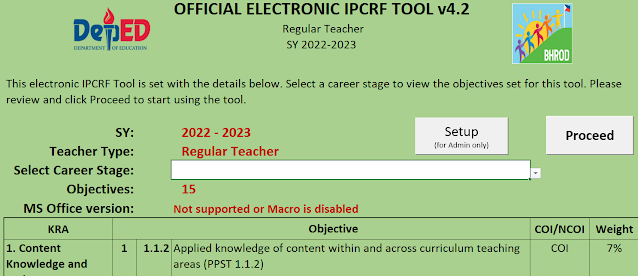
eIPCRF 2023

Understanding the eIPCRF:

The Electronic Individual Performance and Commitment Review Form (eIPCRF) is a standardized assessment instrument developed by the Department of Education (DepEd) in the Philippines. This digital form allows teachers to evaluate their performance based on the DepEd's competency framework, define their commitments, and establish professional development goals.

Key Features and Benefits of eIPCRF:

Streamlined Evaluation Process:
The eIPCRF simplifies the performance evaluation process by providing a structured format for self-assessment. It helps teachers recognize their strengths and areas for improvement, fostering a culture of continuous learning.

Alignment with Competency Framework:
The eIPCRF is aligned with DepEd's competency framework, ensuring that teachers are assessed based on the core competencies required for effective teaching and professional growth.

Goal Setting and Professional Development:
Using the eIPCRF, teachers can set realistic and measurable goals to enhance their teaching skills, create engaging learning environments, and ultimately improve student outcomes.

Digital Accessibility:
Being an electronic form, the eIPCRF allows for easy access and digital record-keeping. Teachers can conveniently update and track their progress over time.

Facilitation of Professional Dialogue:
The eIPCRF encourages meaningful discussions between teachers and their evaluators, fostering a collaborative approach to professional growth.

Download the 2023 eIPCRF Here:

We are delighted to offer you a direct link to download the 2023 eIPCRF. Simply click on the link provided below, and you'll have access to this valuable tool to start your self-assessment and professional development journey:


How Enable Your eIPCRF:

In certain cases, you may need to unblock the file manually to ensure seamless macro functionality. Here's how:
  1. Right-click on the downloaded eIPCRF file.
  2. Select "Properties" from the dropdown menu.
  3. In the Properties window, navigate to the "General" tab.
  4. At the bottom right, you may find a security section with an "Unblock" checkbox.
  5. Check the "Unblock" checkbox and click "Apply" and then "OK."
Enabling Macros in eIPCRF

Open the eIPCRF File in Microsoft Excel:
Locate the downloaded eIPCRF file on your computer and double-click on it to open it in Microsoft Excel. Upon opening, you may encounter a security warning related to macros.

Enable Content and Macros:
To enable the macros and access the eIPCRF's full functionality, follow these steps:
  1. Click on the "Enable Content" button that appears in the security warning at the top of the worksheet.
  2. After clicking "Enable Content," you might come across another security warning specifically related to macros.
  3. Click "Enable Macros" to grant the necessary permissions for the eIPCRF to function properly.

Personal Data Sheet Free Download - CS Form No. 212

Are you in need of the Personal Data Sheet (PDS) or CS Form No. 212? Whether you're a job seeker applying for a government position or a current government employee required to update your information, the PDS is a crucial document. In this comprehensive blog post, we'll guide you on how to easily download the PDS, also known as CS Form No. 212, so you can have all the necessary information at your fingertips.

Personal Data Sheet

What is the Personal Data Sheet (PDS) - CS Form No. 212?

The Personal Data Sheet (PDS) or CS Form No. 212 is a standardized document utilized by various government agencies to gather essential information about individuals applying for civil service positions or those currently working in government service. This form includes personal details, educational background, work experience, and other relevant data required for assessment and evaluation purposes.

Why is the PDS - CS Form No. 212 Important?

The PDS serves as a fundamental tool in the recruitment and selection process within the civil service. It ensures a fair and transparent evaluation of candidates based on their qualifications and merits. Additionally, for existing government employees, updating the PDS regularly is essential for maintaining accurate records and facilitating administrative processes.

Where to Download the PDS - CS Form No. 212?

Accessing the PDS - CS Form No. 212 is a simple and convenient process. To make your search even easier, we have provided direct links below:


Please ensure you are using the latest version of the form from the official website to comply with the most recent guidelines.

Tips for Properly Filling Out the PDS - CS Form No. 212

Filling out the PDS may seem like a daunting task, but with these tips, you'll complete it accurately and efficiently:
  1. Read Instructions Thoroughly: Carefully review the provided instructions before filling out the form. Understanding the guidelines will help prevent mistakes and inaccuracies.
  2. Provide Accurate and Complete Information: Ensure that all personal details, work experience, and educational background are accurate and up-to-date. Double-check your entries to avoid errors.
  3. Be Honest and Transparent: Honesty is crucial when filling out the PDS. Provide truthful information, as any misleading details can have serious consequences.
  4. Seek Assistance if Needed: If you encounter any difficulties or have questions while completing the form, don't hesitate to seek guidance from the appropriate authorities.
The Personal Data Sheet (PDS) or CS Form No. 212 is an essential document for individuals seeking civil service positions and those currently employed in government service. By following the provided download links and tips for filling out the form accurately, you are taking a significant step towards your career aspirations and ensuring a smooth application or updating process.

Remember, the PDS reflects your qualifications and experiences, so take the time to present yourself in the best possible light. Best of luck with your endeavors, and may your journey in public service be successful and rewarding!

Free Download Editable DTR or Civil Service Form No. 48

For employees in both government and private sectors, keeping track of attendance and work hours is an essential administrative task. The Daily Time Record (DTR) or Civil Service Form No. 48 is a crucial document used to record an employee's daily work hours and absences. In an effort to streamline this process and assist hardworking professionals, we are pleased to offer a hassle-free solution. In this blog post, we provide a downloadable and editable DTR form that will simplify your record-keeping tasks, ultimately saving you valuable time and effort.

Download this offline editable DTR. Download it first to edit. (To download this editable DTR, simply click the link above and when it opens in another window to show the DTR online format, click file at the upper left corner and click download on the drop down menu, then choose Microsoft Excel format)

Why is the DTR Form Important?

The DTR form serves as an official record of an employee's attendance, leave credits, tardiness, and absences. Government agencies and private companies use this form to calculate salaries, process benefits, and comply with labor laws. Properly maintaining your DTR ensures accurate payroll processing and avoids discrepancies that could lead to potential issues down the road.

Download Your Editable DTR Form

To alleviate the burden of manual form filling, we have created an editable version of the DTR form that you can easily download. Whether you are an employer responsible for managing your team's attendance or an employee keeping track of your own work hours, this downloadable template is tailored to meet your needs.

Click here to download the Editable DTR Form. It's a user-friendly Microsoft Excel spreadsheet that allows you to input your daily attendance details with ease.

How to Use the Editable DTR Form

Using our downloadable DTR form is a straightforward process. Follow these simple steps to get started:

  1. Download the form using the link provided above.
  2. Save the file to your preferred location on your computer.
  3. Open the Excel spreadsheet using Microsoft Excel or any compatible spreadsheet software.
  4. Fill in the necessary information in the designated columns, such as your name and date.
  5. Enter your daily attendance details, including your time-in, time-out, and any breaks or leaves taken.
  6. The form will automatically calculate the total hours worked for the day, helping you keep track of your work hours efficiently.

Benefits of Using the Editable DTR Form

  1. Time-Saving: The editable DTR form streamlines the process of filling out the DTR, reducing the time spent on administrative tasks. This extra time can now be utilized for more productive and meaningful work.
  2. Accuracy: With automated calculations, you can avoid errors in calculating total work hours, leaves, and tardiness. This ensures accurate records, preventing potential disputes with payroll processing.
  3. Customization: The form is editable, allowing you to customize it according to your organization's attendance policies and specific requirements.
  4. Easy Accessibility: As an electronic file, you can store the editable DTR form on your computer, making it easily accessible for daily updates.

Final Thoughts

Keeping a precise and updated Daily Time Record is essential for both employees and employers. With our downloadable and editable DTR form, you can simplify this vital administrative task, making your work life more efficient and productive.

Remember, maintaining accurate attendance records not only ensures smooth payroll processing but also helps in tracking your own productivity and time management. Embrace this digital solution and take the first step towards a more organized and streamlined work experience.

Download the editable DTR form today and witness the difference it makes in your daily record-keeping journey. Happy tracking!

EastWest Loan for DepEd teachers

 EastWest Bank Loan for DepEd teachers


eastwest loan for teachers

East West Rural Bank is offering salary loan to all DepEd teachers at a very affordable interest rate and a very excellent costumer service.

To apply for a loan just secure the following:

  • 1 pc 2x2 Recent ID Picture
  • Three (3) Consecutive Months Original Payslip
  • Two (2) Valid ID's (PRC and Dep-Ed ID)
  • Authenticated copy of Appointment Letter
  • Authenticated copy of Service Record
To downloan loan form click here.
For more info click here.

ABOUT EASTWEST BANK

Believing that rural banks will continue to play a critical role in countryside development and inclusive growth, EastWest Bank fortified its reach in underserved areas in the country through its rural bank arm, EastWest Rural Bank (EWRB).

EWRB (formerly FinMan Bank, Inc.) consolidates, through an asset acquisition, effective November 1, 2013 the rural banking business of the two rural banks that EastWest earlier acquired, namely Green Bank, Inc. and FinMan Bank, Inc.

FinMan Bank is a 16-year-old rural bank based in Pasig City and engaged in extending credit to farmers, tenants, and rural enterprises. EastWest injected a total of P520 million in fresh capital into EWRB subsequent to the regulatory approval effective May 21, 2013 on the latter’s increase in authorized capital stock from P80 million to P1 billion.

On October 31, 2013, EWRB acquired the good assets of Green Bank, Inc. (also known as the Rural Green Bank of Caraga), the largest rural bank in the Caraga Region in terms of assets. Based in Butuan City, Agusan del Norte, Green Bank has been serving the needs of mostly farmers, government and private employees, barangay officials, pensioners and small-scale businessmen. Through Green Bank’s strong branch network in the Visayas and Mindanao, EastWest is able to gain entry into the microfinance business. READ MORE.

MTMAS/MTSLAI Loan Table For Teachers

 Manila Teachers' Mutual Aid System/ Manila Teachers' Savings and Loan Association - A Blessing To DepEd Teachers


MTMAS (Manila Teachers' Mutual Aid System) or MTSLA (Manila Teachers' Savings and Loan Association) is, for most teachers, a blessing sent from heaven.
MTMAS loan for deped teachers
While the salary of teachers is more than enough to meet the daily needs, it is barely enough to acquire one's dream such as a house and lot. That is why this lending institution is perfect for them.

Below is the loan table. Click the slide to view more and click the full screen to view larger.


MTMAS offers loan to teachers at very low interest rates. Moreover, teachers have loan term options that suit their needs and capability to pay. One's loan at MTMAS can be paid in 12, 15, 18, 24, 30 or 36 months.
One of the reasons why teachers keep coming back to apply a salary loan at MTMAS is that they can take home a much bigger amount upon applying for a reloan on the same monthly deduction basis compared to any other lending groups. What's more, when a teacher is in absolute need, she can come back 2 months after to avail of a reloan with similar monthly deduction.

Not yet a member of MTMAS? Be part of the family and experience its superb costumer service on top of the help it offers you.

HISTORY OF MANILA TEACHERS’SAVINGS AND LOAN ASSOCIATION

The Manila Teachers’ Savings and Loan Association is a non-stock savings and loan association registered with the Securities and Exchange Commission (SEC). It is supervised by the Bangko Sentral ng Pilipinas.

It traces its roots from the humble “paluwagan”, an informal savings system that people organize to generate forced savings among members and enable them to draw from their own resources on which to fall back on in times of emergency.

Under this system, the members choose a treasurer among them. The treasurer collects an agree-upon amount from each member at an agreed-amount regularity. The collective savings of all members is handed over to one member at a time on scheduled dates until all members has received one collection each in a round ribbon fashion. After each member has received one collection, the process is repeated, and so on and so forth.

The Manila Teachers’ Savings and Loan Association was originally one such organization, a teachers’ paluwagan. It was founded by a group of teachers from the Rizal Avenue High School in the late 1950s.

Among them was Mr. Prudencio S. Lacson. He was designated as the paluwagan treasurer. The paluwagan continued to flourish until April 1960, when he retired from teaching.

Visit http://www.mtslai.com/index.html for more information.

The National Learning Camp Does More Harm Than Good

The National Learning Camp Does More Harm Than Good: Unveiling the Detrimental Impact on Students and Teachers

The Department of Education's (DepEd) National Learning Camp (NLC) is introduced in response to the challenges posed by the COVID-19 pandemic, particularly when traditional classroom settings became untenable. The NLC aimed not only to enhance students' academic performance during the summer break but also to fill the gap created by the shift to modular distance learning. However, concerns emerged about the unintended negative consequences this program had on both students and teachers. 

national learning camp

In this blog post, we explore the dual-edged impact of the NLC, highlighting how it was intended to bridge the pandemic-related learning gap while inadvertently leading to teacher burnout and jeopardizing student well-being.

Beyond Academics: The Emotional Toll on Teachers

Teaching is an emotionally demanding profession, one that goes beyond merely imparting knowledge. Teachers are responsible for shaping young minds and, at times, acting as mentors and disciplinarians. This emotional investment often leaves educators vulnerable to stress and exhaustion, especially during the regular school year.

Enter the NLC, a well-intentioned program that aims to maintain students' learning momentum during vacations. However, the camp inadvertently disrupts the much-needed break for teachers, denying them the opportunity to recharge their emotional batteries.

The Impact of Burnout

Teacher burnout is a serious concern that affects not only the educators but also the overall quality of education. When teachers are overworked and deprived of proper rest, they become more prone to stress-related illnesses, reduced job satisfaction, and diminished performance in the classroom. Burnout can also lead to higher absenteeism rates, impacting the learning experience of students who rely on consistent and dedicated teaching.

The Forced Participation Predicament

One of the most troubling aspects of the NLC is the contrasting reality between its intended voluntary nature and the mandatory participation enforced in many schools. On paper, the NLC was designed to offer teachers the choice of engaging in the program. However, in practice, many educators find themselves caught in a dilemma: either participate in the camp or face potential consequences, such as being reprimanded. This coercive approach leaves educators with little choice but to sacrifice their well-being for the sake of the program.

While the DepEd may officially present the NLC as a voluntary opportunity for teachers to contribute to the learning enhancement of students during vacations, the ground reality can be vastly different. The pressure to conform to school policies, especially in regions where educational resources are limited, leaves teachers feeling compelled to participate in the NLC regardless of their personal needs and well-being.

The Importance of Rest and Recovery

Rest is not a luxury; it is a necessity for maintaining good mental and physical health. Long vacations offer teachers the opportunity to recuperate from the demands of the academic year and reconnect with their personal lives, interests, and families. Forcing teachers to work during this time denies them the essential space for relaxation, recuperation, and rejuvenation.

Impact on Students: The Deprivation of Rest and Wellness Due to NLC

The DepEd's National Learning Camp (NLC), while aiming to enhance students' academic performance during the summer break, inadvertently deprives students of valuable time for rest, relaxation, and overall well-being. The NLC's demands on students' time and energy leave little room for them to enjoy their vacation fully, leading to potential consequences that extend far beyond the classroom.

Deprivation of Rest and Sleep

Summer break is an essential period for students to catch up on much-needed rest and sleep. However, the NLC places academic demands on them, reducing their opportunities for quality sleep and relaxation. The lack of adequate rest can lead to fatigue, difficulty in concentrating, and diminished cognitive abilities, hindering their ability to learn effectively in the following academic year.

Limited Time with Family and Pursuit of Hobbies

Long vacations offer a unique opportunity for students to bond with their families and engage in activities they enjoy, such as pursuing hobbies or interests outside of academics. The NLC's rigorous schedule can limit the time students spend with their loved ones and hinder their chances to explore their passions, potentially affecting their emotional well-being and overall happiness.

Impact on Health and Recovery

Students face immense pressure and stress throughout the school year, and the summer break provides a crucial period for them to recover from any physical or mental illnesses caused by academic pressures. Depriving students of this much-needed recovery time can result in a compromised immune system, making them more susceptible to illnesses when the new academic year starts.

Preparation for the New School Year

The summer break also serves as a preparation period for the upcoming school year. Students need time to gather their thoughts, plan their studies, and mentally prepare themselves for new challenges. The demands of the NLC can disrupt this preparation, potentially leading to students feeling overwhelmed and unprepared when classes resume.

Long-term Impact on Students

A school system that focuses primarily on academics, neglecting the health and overall well-being of students, can have lasting consequences on their future. Unhealthy, stressed, and overburdened students may struggle to reach their full potential, hindering their development as well-rounded individuals who can contribute positively to society.

A Call for Balancing Academics and Wellness

While participation in the NLC may be voluntary, students and parents may feel compelled to engage due to various reasons, such as peer pressure or concerns about academic progress. DepEd should consider the long-term impact of this program and strike a balance between academic enhancement and student well-being.

Promoting initiatives that prioritize student health, encourage family time, and allow students to explore their passions during the long vacation can lead to a more holistic and nurturing educational environment.

Remembering Jose Rizal's wise words, our youth indeed represents the future of our motherland, and their well-being should be a central concern for any educational institution. Emphasizing the importance of rest, wellness, and a well-rounded education can ensure that our students grow into healthy, confident, and capable individuals, ready to shape a bright future for the nation.

DepEd Urges School Administrators to Simplify Graduation Ceremonies and Minimize Expenses for Parents

The Department of Education reminds School Administrators to keep graduation ceremonies simple and avoid burdening parents, especially in terms of expenses. This was emphasized by DepEd Central Visayas Regional Director Salustiano Jimenez in a statement to the media.


Jimenez further stated that the DepEd always advises all schools to make the Commencement Exercises and Graduation Ceremonies as modest as possible. It is known that the academic year's closing ceremonies will take place on July 10, so they urged teachers, principals, and school administrators to refrain from requesting contributions from parents.

Additionally, Jimenez emphasized that there should be no mandatory fees collected, except when parents voluntarily agree to contribute towards specific items, such as the use of graduation gowns or sharing their desired arrangements for their children's graduation.

Jimenez also encouraged those who have complaints regarding fees or any issues related to graduation to address them directly to the school administration, assuring them that immediate action will be taken.